
What I Learned at Stripe Tour Singapore 2026
The real opportunity is not a new financial universe; it is a better settlement layer between familiar fiat endpoints—one that reduces the exception tax of cross-border payments: delays, FX leakage, prefunding, reconciliation, and capital trapped in transit.


The most interesting thing at Stripe Tour Singapore was how boring stablecoins sounded. Not boring in the sense that nobody cared. Boring in the sense that the technology had finally been described as infrastructure.
Stripe called it the stablecoin sandwich.
Fiat goes in. Stablecoins move the money. Fiat comes out.
The sender pays in a currency they know. The recipient receives a currency they can use. Somewhere in the middle, a stablecoin moves value across a border without waiting for correspondent banks, settlement windows, or the next business day.
The point is not to make a customer hold a token. The point is to make a cross-border payment feel less like a cross-border payment.
That may be the most consequential evolution in the stablecoin story.
For years, the industry framed stablecoins as an alternative financial universe: a place where people might eventually live, save, spend, borrow, and invest outside the familiar banking system. The more practical version is narrower and more powerful.
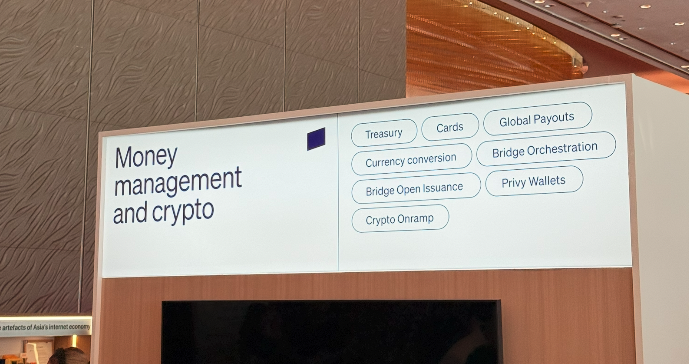
Stablecoins are becoming a settlement tool.
They are useful not because a business wants to become a crypto company, but because a business wants money to arrive sooner, cost less to move, and create fewer exceptions for finance and operations teams.
The Payout Problem
Consider a $10,000 payout from a company in the United States to a recipient in the Philippines.
The instruction may be submitted in seconds. The money itself hasn't left.
It can pass through the sender’s bank, correspondent banks, FX providers, payout partners, local banking rails, compliance checks, and reconciliation systems. Each participant has its own ledger, operating hours, cutoffs, pricing, and tolerance for risk.
The result is a familiar set of delays:
- The payment misses a bank cutoff
- A weekend interrupts settlement
- Funds move through more than one correspondent bank
- FX is priced across multiple handoffs
- A payout partner needs prefunding before it can release local currency
- An operations team investigates a missing or mismatched transaction
- Capital remains unavailable while records catch up to the money
The cost is not only a fee on the payment.
It is the working capital held in advance. It is the finance team reconciling multiple reports. It is the merchant or recipient asking where the money is. It is the decision to delay entry into a new market because another payout flow would create another operational system to manage.
This is the exception tax.
Every market introduces a set of exceptions. Every exception becomes a workflow. Every workflow consumes people, time, capital, or all three.
The Sandwich
The stablecoin sandwich changes the middle of that journey.
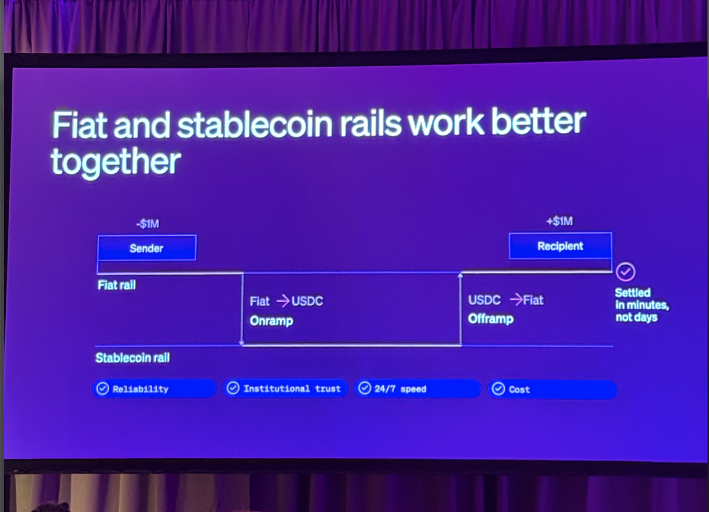
A sender’s funds are converted from fiat into a stablecoin at the origin. The stablecoin settles across the network. At the destination, it is converted back into local fiat and paid into the recipient’s bank account or preferred local endpoint.
The user need not receive a stablecoin. The operator need not expose crypto terminology in the product. The relevant unit of value at both ends remains familiar currency.
Stripe presented this model as a way to reduce settlement times and costs for fiat-to-fiat payouts. In its example, a US–Mexico flow moved from nearly a day to under two hours.
The lesson is not that stablecoins remove all complexity. They change where complexity sits.
What It Fixes
A stablecoin settlement leg can help with problems that occur between two regulated fiat endpoints.
It can reduce dependency on bank operating hours. It can shorten the period during which funds are in transit. It can make cross-border movement more programmable. It can reduce the number of intermediaries involved in the middle of a payout flow.
For an operator, these improvements show up in a handful of measures:
| Step | Conventional payout | Stablecoin sandwich |
|---|---|---|
| Origin | Fiat funds enter a bank-led cross-border flow | Fiat is converted into a stablecoin |
| Cross-border leg | Correspondent banks, cutoffs, and intermediary processing | Stablecoin settlement occurs continuously |
| Destination | Local payout depends on bank and provider processing | Stablecoin is converted into destination fiat |
| Recipient experience | Receives local currency, often after delays | Receives local currency, potentially sooner |
| Operator challenge | Multiple handoffs and reconciliation points | Fiat endpoint, local liquidity, compliance, and reconciliation still matter |
The stablecoin sandwich is useful when it lowers one or more of these costs in a measurable way.
A good implementation should not begin with, “How do we add stablecoins?”
It should begin with, “Which part of our money movement creates the most expensive exception?”
What It Does Not Fix
The hard parts of cross-border payments do not disappear because a settlement leg runs on-chain.
The recipient still needs an endpoint. That endpoint still needs local currency liquidity. The business still needs to know who is sending and receiving money. The provider still needs to manage sanctions screening, transaction monitoring, fraud, chargebacks where relevant, and local regulatory obligations.
Most importantly, the off-ramp remains a real-world problem.
A stablecoin can cross a border in minutes. Turning it into usable Philippine pesos requires regulated access to local accounts, payout rails, liquidity, compliance operations, and reconciliation. Those capabilities take time to build because they depend on local institutions, local licenses, and local trust.
This is why the off-ramp is more than a technical feature. It is an operating capability.
The blockchain may be global. The endpoint is always local.
The Infrastructure Shift
Stripe’s larger proposition at the event was not simply that stablecoins might make payouts faster.
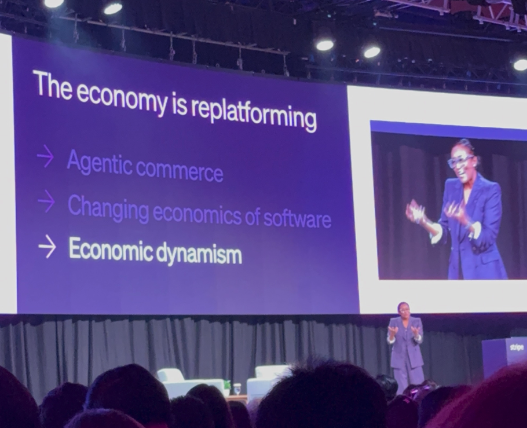
It was that the old operating model of global expansion is being compressed.
Historically, a new market meant a new cluster of work: local payment methods, currency management, entity setup, tax handling, fraud controls, banking relationships, payouts, and customer support. Stripe’s roadmap points toward a world where more of that complexity can be managed from a shared infrastructure layer.
The ambition is not borderless money.
It is fewer exceptions.
One integration can add payment methods. A centralized balance can hold and convert currencies. A managed layer can take on part of the compliance burden. A stablecoin settlement leg can reduce the pauses between two fiat systems.
None of these features matters in isolation. Together, they change the operating cost of entering the next market.
That is the real strategic shift.
The Philippine Question
For Philippine businesses, the opportunity is not to adopt stablecoins because they are novel.
It is to identify where existing cross-border flows are slow, capital-intensive, or operationally fragile, then determine whether a new settlement layer materially improves the result.
For global businesses, the opportunity is the mirror image: making it easier to collect from, pay into, and operate within the Philippine digital economy without treating the country as an exception-heavy endpoint.
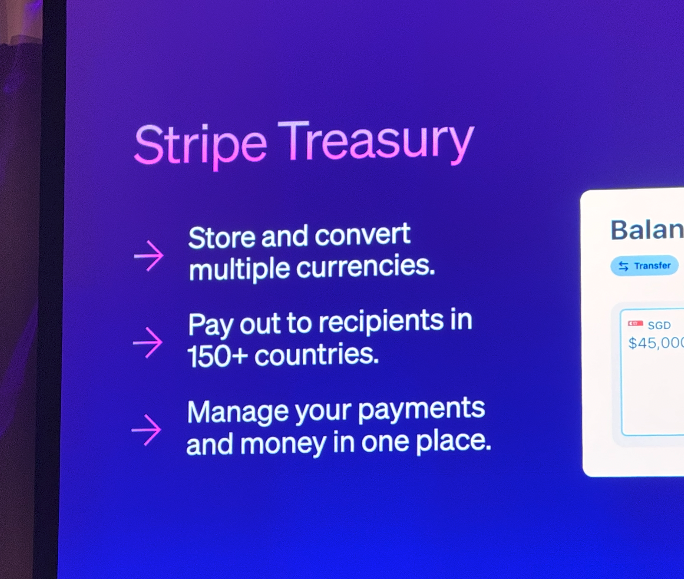
The eventual winner will not be the provider that gives merchants the most technical choices.
It will be the provider that lets a business collect, hold, convert, and move money across markets without needing to understand the banking partners, FX routes, stablecoin networks, settlement mechanics, or exception queues underneath.
That is what mature infrastructure looks like.
It becomes boring.
And then it becomes indispensable.

Accept payments from Filipino customers without a Philippine entity.
Most global companies stall in the Philippines for one reason: local acceptance requires local infrastructure. An entity, a resident agent, a bank account you cannot open remotely, and months of setup before the first peso clears.
PayMongo is the licensed local endpoint. One integration, one contract, settlement and compliance handled under our Philippine licence.
PayMongo is regulated by the Bangko Sentral ng Pilipinas.